SMS Automation Compliance Rules Every Agency Must Follow
This guide covers exactly what needs to be in place for sms automation compliance: TCPA consent mechanics, quiet hours, consent documentation, suppression list architecture, and how to structure SMS workflows inside platforms like GoHighLevel and HubSpot so compliance runs automatically, not manually.
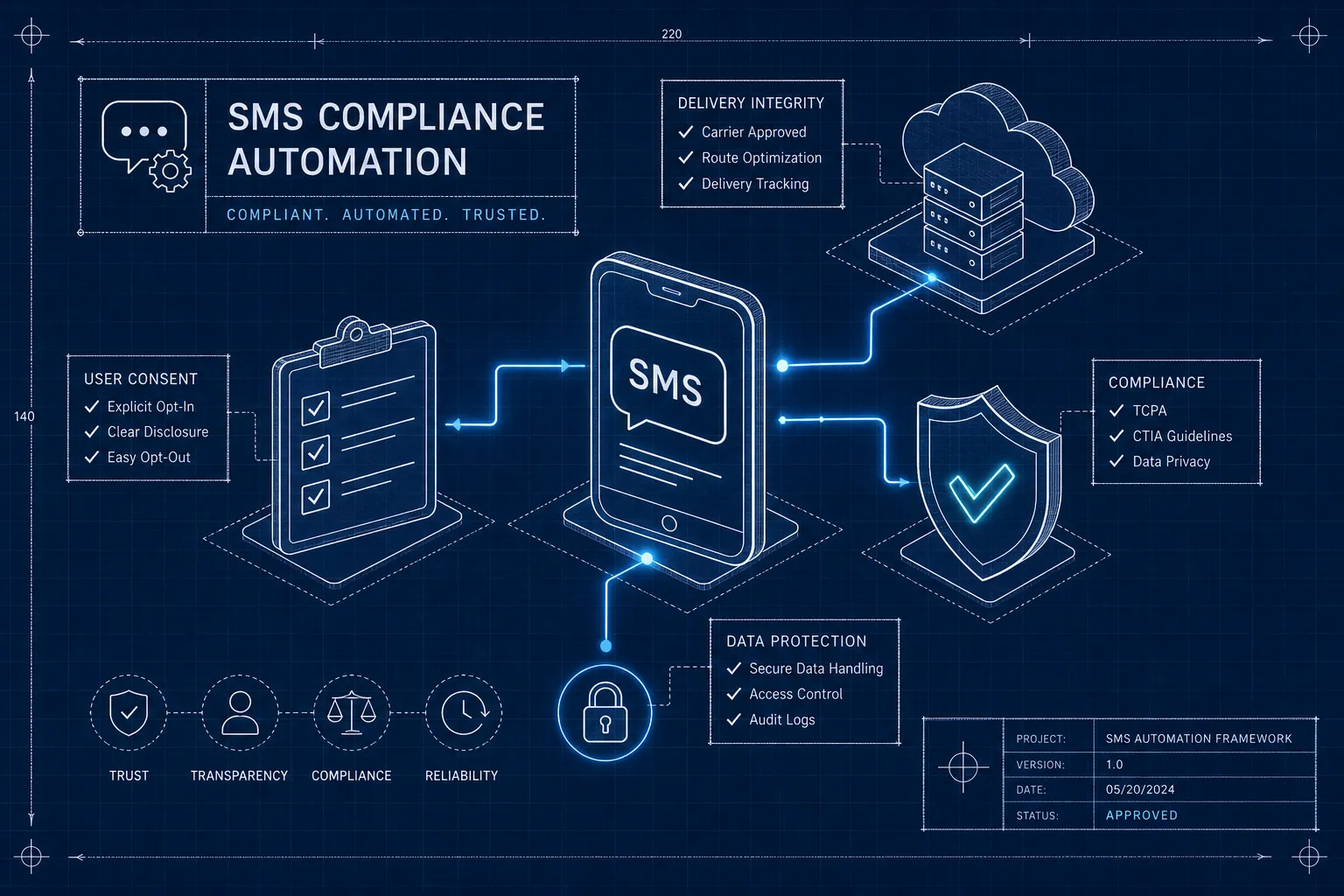
SMS automation compliance is not theoretical, a $1,500 fine per message is not a worst-case scenario. It's the statutory penalty for every willful TCPA violation, applied to every recipient on the list. Send a non-compliant promotional text to 10,000 contacts and you're looking at $15 million in exposure. That liability can attach to the business sending the messages and, depending on the facts and contractual arrangements, to the agency that built the workflow, a position supported by FCC guidance on third-party sender responsibility.
At VELO, the team sees this regularly during new client audits: SMS automations that are live, scaling, generating leads, and quietly accumulating legal risk because nobody built compliance into the architecture before launch. The consent form collected a phone number but without documented disclosure language. The opt-out keyword mapped to a tag but didn't update the suppression list. The quiet hours logic was set for Eastern time and nobody accounted for contacts in California. These aren't rare exceptions. They're common patterns in agency-built CRM automations that were built for speed over structure.
This guide covers exactly what needs to be in place for sms automation compliance: TCPA consent mechanics, quiet hours, consent documentation, suppression list architecture, and how to structure SMS workflows inside platforms like GoHighLevel and HubSpot so compliance runs automatically, not manually.
SMS Automation Compliance: What TCPA Actually Requires Before You Hit Send
The governing standard for all promotional SMS is prior express written consent, commonly abbreviated as PEWC. A February 2025 Fifth Circuit ruling created some legal ambiguity by suggesting only "prior express consent" is required, but the FCC still mandates the written standard, and most businesses and agencies continue enforcing it for good reason. At $1,500 per message for willful violations, betting on the weaker court interpretation is not a risk worth taking.
Written consent means a documented, affirmative action taken by the consumer: a checkbox click, a form submission, or a keyword reply. Verbal consent doesn't qualify. A business card with a phone number on it doesn't qualify. If it isn't documented, it didn't happen.
The five consent elements your opt-in must capture right now
Every compliant opt-in form must include five specific disclosures before the first message goes out. The sender's business name must appear in a clearly identifiable form consistent with how it appears on outgoing messages, FCC and CTIA guidance require consumers to know exactly who is messaging them. Generic "partner" opt-in clauses have been invalid since the FCC's one-to-one consent ruling (FCC 23-107, effective January 2025), which requires individualized written consent for each brand. The form must describe the nature and frequency of the messages and state clearly that they will be autodialed. It must confirm that consent is not required to make a purchase. And it must include opt-out instructions alongside a data-rates disclosure.
Miss any one of these five elements and the consent record won't hold up under scrutiny. All five need to be present, visible, and documented at the moment the consumer submits the form, not buried in a linked privacy policy three clicks away.
What the 2026 legal landscape didn't change for agency-built workflows
One question that comes up often in agency builds: does a single opt-in cover multiple message types from the same sender? As of 2026, yes, it can, as long as the consent language is explicit and the sender name on the form matches the sender name on every outgoing message. What it cannot cover is third-party brands or vague "affiliated partners." The sender identified at opt-in is the only sender with authorization to message that contact. For agencies building multi-client automations, best practice, and the recommendation of TCR carrier guidelines, is to configure sender identity at the sub-account level rather than sharing it across a parent account, to ensure each client's consent chain is clean and independently defensible.
Quiet hours, content restrictions, and the carrier rules that bypass TCPA
Federal TCPA sets the quiet hours floor at 8 a.m. to 9 p.m. in the recipient's local time zone. That's the minimum. Florida enforces a stricter window of 8 a.m. to 8 p.m. under its state-level consumer protection statutes. Texas SB 140, effective September 2025, restricts unsolicited commercial messages and establishes a 9 a.m. to 9 p.m. window Monday through Saturday with a noon start on Sundays, though its application to fully solicited marketing messages involves additional nuance, and agencies should review the statute directly for their specific use cases. For any agency running multi-state campaigns, a blanket national schedule won't cut it. The workflow needs time-zone-based send logic built in at the automation level.
Quiet hours are also not just about legality. Sending outside compliant windows directly affects deliverability and carrier complaint rates, and once complaint thresholds trigger carrier filtering, even compliant messages get blocked. A 9:45 p.m. promotional text to a Florida contact is both a legal violation and a fast path to a carrier complaint, which brings up the parallel compliance framework that many agency owners treat as fine print.
SHAFT content and the CTIA rules carriers enforce independently
The CTIA Messaging Principles operate alongside TCPA, not beneath it. Carriers can filter or block SMS campaigns that violate CTIA content rules regardless of whether the sender is fully TCPA-compliant. The five SHAFT categories, Sex, Hate, Alcohol, Firearms, and Tobacco, are blocked across A2P SMS at the carrier level. Cannabis references are blocked even in states where cannabis is legal. Any promotional language added to a transactional message reclassifies that message as marketing, triggering the higher PEWC consent standard. For a clear summary of how TCPA and CTIA compliance interact with carrier filtering, see this industry overview on TCPA and CTIA compliance.
This reclassification point trips up a lot of agency builds. An appointment reminder is transactional. An appointment reminder that includes "mention this text for 10% off your next visit" is now a promotional message, and every contact who received it without PEWC on file is a potential violation.
Structuring SMS Automation Compliance Through 10DLC Registration
A2P 10DLC brand and campaign registration through The Campaign Registry is mandatory for any business-to-consumer SMS at scale. Non-registered campaigns get throttled or blocked outright by AT&T, Verizon, and T-Mobile. Registration requires a verified brand, legal business name, EIN, entity type, and a campaign submission with sample message templates, opt-in proof, and a description of the message flow. If you need a practical primer on A2P 10DLC and campaign registration, this beginner's guide to A2P 10DLC campaign registration is a helpful resource.
This is not optional, and it's not a setup step you can defer and backfill cleanly. Many agency-built workflows skip 10DLC registration during initial build and only discover the problem when open rates collapse and nobody can explain why. By that point, the fix requires re-registration, carrier resubmission, and often rebuilding campaign associations from scratch.
What compliant consent documentation actually looks like
Most agency owners understand the concept of getting consent. Fewer understand that getting consent and documenting it in a legally defensible way are two different things. A checked box on a form proves nothing if the system didn't record when it was checked, what language surrounded it, and which phone number it applied to.
The six data points every consent record must contain
A complete consent record requires six specific elements: the exact date and time of consent, the method of capture, the precise consent language displayed to the consumer at that moment, the affirmative action taken (checkbox click, keyword reply), the phone number specified in the consent, and a traceable identifier like an IP address or form ID. These six fields form the audit trail. If a TCPA complaint comes in and you can produce a record with all six, you can defend the consent. If the record is missing even one, the defense gets significantly harder.
How long to keep records and how GDPR differs
TCPA requires four years of consent records. GDPR takes a different approach: no fixed minimum, but records must be maintained as long as they're needed to prove consent if challenged. For agencies managing clients with EU-resident contacts in their CRM, this distinction matters. The practical recommendation is to keep all consent records indefinitely until the contact explicitly opts out and invokes erasure rights, then document that deletion too. This approach satisfies both frameworks without requiring you to manage different retention schedules by contact jurisdiction.
Suppression lists, opt-out windows, and who carries the liability
Since April 2025, TCPA requires businesses to accept opt-outs through any reasonable channel, not just STOP keyword replies. Opt-outs received via email, form submission, or phone call must feed into the same suppression logic as a STOP reply. Under TCPA's implementing regulations, opt-outs must be honored within 10 business days at most, and most major platforms process them immediately. The critical point for agency owners: a contact who opted out of promotional messages and then received one because the suppression list wasn't synced to a new workflow creates fresh TCPA liability on every single message sent after that opt-out.
Structuring compliant SMS workflows in GoHighLevel or HubSpot
Understanding the rules is one thing. Building a CRM architecture that enforces them automatically is another. The most common failure points in agency-built SMS automations are consistent across platforms: opt-out keywords mapped to tags but not to contact status updates, suppression lists living inside one campaign without syncing to others, transactional and promotional message streams sharing the same pipeline triggers, and consent capture forms collecting phone numbers without logging the disclosure language shown at the moment of capture. These are the gaps that make an otherwise functional automation a compliance liability.
How to wire opt-out flows so suppression happens automatically
A compliant opt-out workflow in GoHighLevel follows a specific logic chain. An inbound STOP keyword triggers an immediate contact status change to "SMS Unsubscribed." That status update feeds the master suppression list. Every SMS action in every automation checks that list before sending. The workflow also triggers an opt-out confirmation message to the contact. Since April 2025, opt-outs received through any channel, including email, web forms, and phone calls, must also feed into this same suppression logic, not just the STOP keyword trigger.
In HubSpot, native SMS compliance features are more limited. The platform supports opt-in consent collection via form checkbox and STOP keyword handling, but automatic suppression list syncing across all workflows requires a compliant third-party SMS integration (Sakari and Salesmsg are common choices) plus custom contact properties that track consent source, timestamp, and opt-out status. The workflow logic must bridge the third-party tool and the HubSpot contact record so a STOP reply in the SMS platform immediately updates the HubSpot property and excludes the contact from future sends. For teams focused on platform builds and integrations, see our work with Technology & SaaS, VELO clients for examples of compliance-first architectures.
Separating transactional and promotional message streams in your CRM
Keeping these two streams architecturally separate inside the CRM is non-negotiable, not just a best practice. Transactional messages carry a lower consent burden: a customer who provides their phone number during a transaction has implicitly consented to relevant updates. But that consent doesn't extend to promotional messages. The moment a transactional message includes an offer, a discount, or any marketing language, it becomes promotional and requires PEWC on file.
The right build separates these at the pipeline level. Promotional triggers are gated behind a contact property that confirms PEWC status. Transactional triggers pull from a separate workflow branch that doesn't require written consent but still includes opt-out instructions and respects suppression status. Mixing the two streams in the same pipeline is how a compliant transactional workflow becomes a compliance liability at scale.
Platform features that enforce compliance rather than assume it
The question with any SMS platform isn't whether compliance features exist, it's whether they're active by default or require deliberate configuration to function. Consent capture with timestamps, automatic suppression list updates on STOP, full audit logs recording delivery and opt-out actions, quiet hours enforcement at the platform level rather than just in the workflow logic, and rate throttling that respects carrier limits: these are the five non-negotiables for any compliant SMS automation compliance setup.
GoHighLevel supports all five but requires intentional configuration, particularly for suppression list syncing across sub-accounts, this is not enabled out of the box and needs to be verified for each client build. HubSpot requires third-party integrations to cover most of these natively. Twilio offers the most customization but also the most configuration work; its compliance enforcement is only as strong as the implementation. For an additional perspective on TCPA compliance mechanics and platform responsibilities, review industry guidance on TCPA compliance for SMS.
How VELO builds compliance guardrails into every SMS automation from day one
The distinction isn't which platform a client uses. It's whether the compliance layer was architected into the CRM build before the first message went out or bolted on afterward. At VELO, every SMS automation build includes documented consent capture with timestamp logging, automated suppression list syncing across all active workflows, quiet hours enforcement configured by recipient time zone, separated transactional and promotional pipeline streams, and 10DLC registration completed as part of initial setup. Clients don't choose between speed and legal safety. Those aren't in conflict when the build is done correctly from the start.
The real risk isn't complexity
SMS automation compliance isn't about reading FCC documents. It's about building systems that handle consent, documentation, and suppression automatically so human error doesn't create $1,500-per-message exposure. The rules are knowable. The architecture is buildable. The actual risk is running live campaigns on a CRM that was never set up to handle compliance in the first place, and finding out there's a problem through a complaint rather than an audit.
If your SMS workflows are live and you haven't audited the consent capture logic, the suppression list syncing, or the opt-out flows recently, that's where to start. VELO offers a free 30-minute pipeline audit that identifies the three highest-leverage gaps in your existing CRM setup, with a written roadmap delivered within 48 hours. That audit is where you find the gaps, before a complainant does. For a practical, step-by-step look at industry opt-in and opt-out messaging examples you can implement as part of that audit, see this resource on SMS opt-in message examples.
Contact VELO to schedule your audit and get a compliance-first roadmap that prevents regulatory exposure while preserving the business value of SMS as a channel.