Real Estate Pipeline Audit: 3 Leaks Killing Your Deals
At VELO, we've run pipeline audits for real estate teams across the country, and the same three gaps surface consistently regardless of team size, platform, or market. The leaks are predictable. They're also fixable.
Most real estate teams running paid ads believe their pipeline is working because deals are still closing. A quick pipeline audit usually tells a different story. The deals still closing tell you nothing about the deals you never see. Those leads came in, got lost, went cold, and eventually called someone else. You attributed it to bad lead quality. It wasn't.
At VELO, we've run pipeline audits for real estate teams across the country, and the same three gaps surface consistently regardless of team size, platform, or market. The leaks are predictable. They're also fixable. This article walks through what each one looks like, what it costs you, and how to find it in your own setup.
Why most real estate pipelines are silently leaking revenue
The deals you lose but never see
The most dangerous pipeline failures don't announce themselves. A lead doesn't throw an error or bounce back. It just goes quiet. Your team moves on, assumes the lead wasn't serious, and the whole episode gets filed under "bad lead quality." What actually happened is the system failed, not the lead.
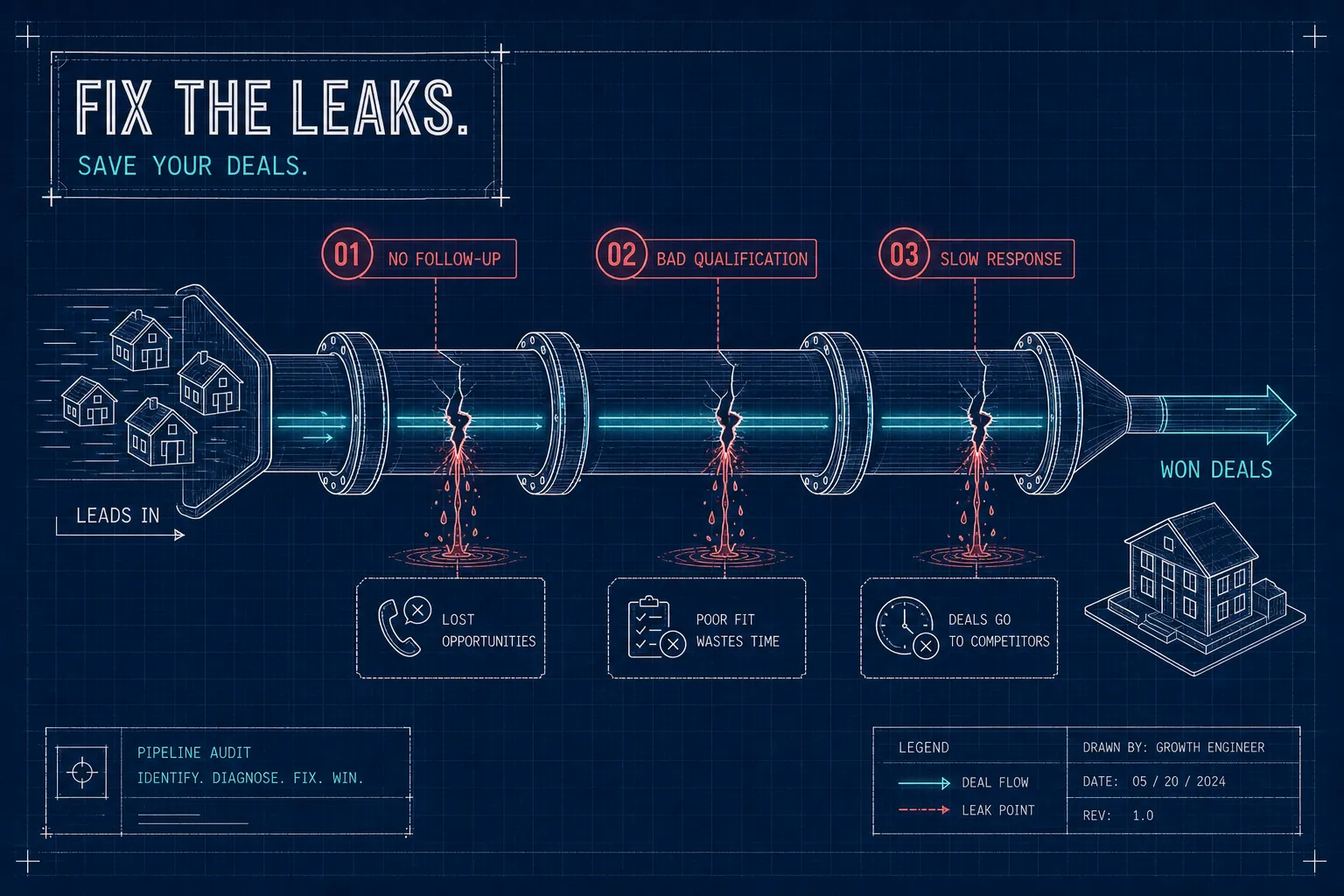
Revenue is leaking at three very specific points in nearly every real estate pipeline we review. Each one is invisible from the outside and completely fixable once you know where to look. The first step is stopping the assumption that your pipeline works because some deals close. Some will always close. The question is how many you're leaving behind.
What a pipeline audit actually reveals
A pipeline audit is a structured diagnostic on how leads move from first touch to close, where they stall, and whether your system is actually doing what your team thinks it is. It's not a quarterly review. It's not a pipeline meeting. Those are backward-looking check-ins on what happened. An audit examines the system itself.
The difference matters because most pipeline problems aren't visible in deal reports. They live in the gaps between what your CRM is supposed to do and what it's actually doing at 9pm on a Tuesday when a lead comes in from a Facebook ad and nobody's watching. That's precisely why a pipeline review vs. audit distinction is worth understanding: reviews surface results, audits surface the reasons behind them.
Leak #1: Lead assignment that takes hours instead of minutes
Why speed-to-contact is a deal, not a preference
This isn't a hustle problem. It's a routing problem. Leads contacted within 60 seconds convert at 23.4%. Leads contacted after 30 minutes convert at 4.8%. That's a 4.9x gap between fast and slow, and the median brokerage response time is over four hours. The average agent takes more than 15 hours to respond. By then, the lead has moved on. For more context on those response-time impacts and industry benchmarks, see this summary of real estate lead statistics.
Seventy-eight percent of buyers work with the first agent who responds. That's not a preference; it's a pattern. If your routing process depends on someone checking a shared inbox or a manager manually assigning leads before anything happens, you're not competing on speed. You're hoping your lead didn't also fill out a form somewhere else.
How to audit this in your current setup
Pull your CRM and compare two timestamps: lead_created_at and first_contacted_at . If that gap is longer than five minutes on average, your routing is broken. Broken routing typically looks like one of three things: leads sitting in a shared inbox waiting to be claimed, round-robin rules that skip agents who are unavailable, or a manual assignment step that creates a delay before the lead ever hears from anyone.
The fix isn't coaching your agents to respond faster. The fix is making sure a lead never waits for a human decision before the first touch goes out.
What a fixed assignment system looks like
Auto-assignment based on territory, lead source, or agent availability, with an automated first-touch message going out within 60 seconds of lead creation. This isn't a sophisticated build. It's a basic CRM configuration. Many teams don't have it in place simply because nobody sat down and defined the rules. Once it's configured, every new lead gets an immediate response without anyone having to remember to trigger it.
During audit evidence collection for this leak, check whether your CRM logs show a routing rule firing at the moment of lead creation. If there's no system-generated event tied to that timestamp, the automation doesn't exist yet.
Leak #2: Prospects past 30 days get nothing
The biggest ignored segment in your database
Real estate teams concentrate their follow-up energy on the last 7 to 14 days of leads. Everyone else gets forgotten. The problem is that real estate buying cycles are long. Buyers and sellers researching today often close three to six months from now. Some portal leads have nurture cycles stretching well past 24 months. Your database is full of people who are still going to buy. They're just not ready yet.
Agents abandon 88% of online leads within 30 days. That number represents a full database of future deals written off because follow-up stopped before the lead was ready to move. Research on long-cycle real estate conversions consistently shows that the 30-to-180-day window holds a significant share of eventual closings. Most teams aren't touching it at all.
How to audit this in your current setup
Open your CRM and filter for leads created more than 30 days ago with no scheduled follow-up activity and no recent touchpoint. If that list is long, you have a nurture leak. Look specifically for contacts with no email opens in 60-plus days, no call logged in the past month, and no active sequence enrollment. That's your dead zone, people who expressed interest in working with you and then heard nothing.
What a working nurture system looks like
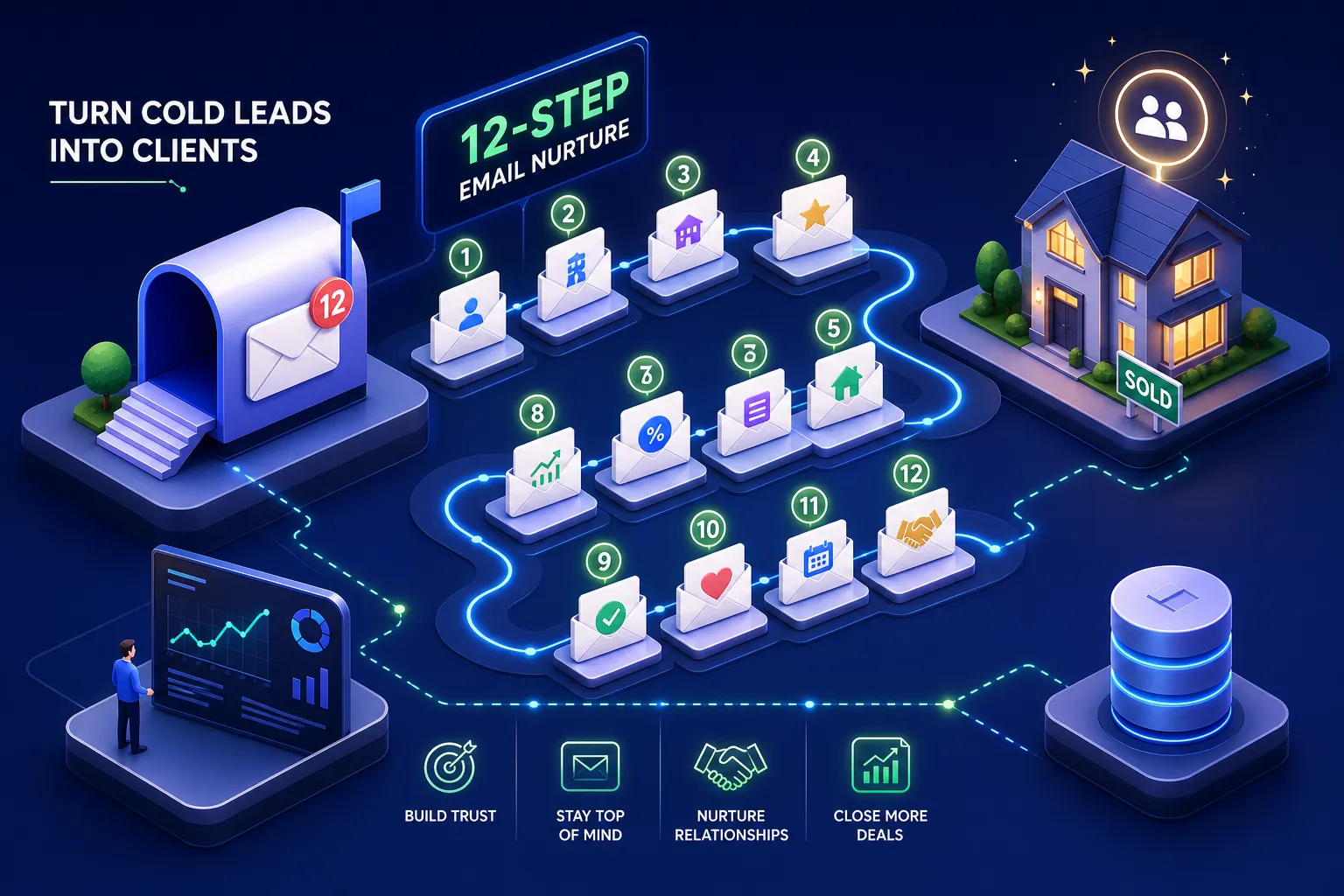
A real long-cycle nurture sequence runs automatically in the background without requiring any agent to remember anyone. Value-based email touches, behavior-triggered check-ins, and periodic SMS re-engagement spread across weeks and months. When a lead clicks a listing or revisits your site, the system responds. When 90 days pass with no activity, a check-in goes out asking if the timing has shifted. For practical examples of automated nurture flows, see this guide on an automated nurture sequence, and for ideas on multi-touch drip campaigns consult this real estate drip campaigns write-up.
The goal isn't to badger leads into submission. It's to stay present so that when the timing does shift, your team is the first call they make, not because they searched for you again but because you've been consistently showing up.
Leak #3: You can't trace which sources are actually closing deals
The attribution gap that wastes your ad budget
Most teams know their lead volume by source. Very few know their close rate by source. That gap is expensive. Consider a straightforward example: a source generating 200 leads a month at a 0.5% close rate produces one deal per month. A source generating 40 leads at a 6% close rate produces 2.4 deals, at a fraction of the volume. Without attribution data connecting source to close, budget decisions are guesses dressed up as strategy.
The downstream cost isn't just wasted spend. It's the compounding effect of doubling down on channels that generate noise while underfunding the channels that generate revenue. Every month without clean attribution is another month of budget allocated by assumption.
How to audit your attribution setup right now
Pick your top three lead sources from the last quarter and calculate the actual close rate for each. If you can't pull that number directly from your CRM, if you have to export spreadsheets and cross-reference manually, your attribution is broken. Common failure points include leads not tagged with a source at creation, UTM parameters not passing into the CRM, and closed deals not linked back to the originating lead record. Pipeline compliance audit standards for regulated industries add another layer here: you need a complete data pipeline audit log showing source tagging at every stage, not just at entry. If you're evaluating how to instrument that pipeline end-to-end, reviewing best practices for marketing attribution can help clarify the tagging and tracking steps you need in place.
What clean attribution makes possible
When attribution works, you can see cost per qualified lead by source, close rate by channel, and revenue influenced per campaign. That changes every budget conversation. You stop funding sources that generate volume with no conversion and redirect toward what's actually closing. The data doesn't just tell you what happened. It tells you where to put the next dollar.
Pipeline audit checklist
Before pulling any reports, use this checklist to frame your audit. Work through each item and note whether you can answer with actual data or only with an assumption.
-
Are leads being contacted within five minutes of entry? (Pull lead_created_at vs. first_contacted_at for the past 30 days.)
-
Do your CRM routing rules fire automatically at lead creation, with no manual step required?
-
Are leads older than 30 days enrolled in an active nurture sequence?
-
Does your CRM show sequence enrollment rates for contacts created 30-to-180 days ago?
-
Are all inbound leads tagged with a source at the point of creation?
-
Are UTM parameters from paid campaigns passing cleanly into your CRM?
-
Can you trace a sample of 10 recently closed deals back to their originating source and campaign?
-
Do your closed deal records link back to the originating lead record (not just the contact record)?
-
Is your pipeline compliance audit log capturing source tagging, assignment events, and sequence enrollment in one place?
-
Can you produce close-rate-by-source data without exporting to a spreadsheet?
If you answered "no" or "I'm not sure" to three or more of these, you have at least one active leak. Most teams find gaps in all three areas. If you'd like a quick reference while you work through the checklist, check our FAQ, VELO Agency for common questions and definitions.
How to run a quick pipeline audit on your own setup
The three questions to answer first
Before pulling any reports, frame the audit around three questions. Are leads being contacted within five minutes of entry? Are leads past 30 days enrolled in any active sequence? Can you trace any closed deal back to its originating source and campaign? If you can answer yes to all three with data to back it up, your pipeline is in reasonable shape. In practice, many teams find they can't answer yes to any of them.
Where to look in your CRM
Check your lead routing rules and look at assignment timestamps. Review sequence enrollment rates for contacts older than 30 days. Pull a sample of 10 recently closed deals and trace each one back to its source. You're not trying to write a compliance report. You're looking for the leaks. Directional clarity is enough to identify where the biggest losses are happening.
What to do when you find the gaps
Prioritize by revenue impact. Lead assignment failures affect every new lead coming in, so they bleed the most. Nurture gaps affect your existing database of leads you've already paid to acquire. Attribution issues affect future budget decisions. As a recommended prioritization, fix them in that order: routing first, nurture second, attribution third. Teams that tackle routing first typically see the fastest measurable improvement since it affects every new lead from that point forward.
What to do when the gaps are bigger than a quick fix
Why a fresh set of eyes matters
When your pipeline has been patched together over time, different tools added at different stages, workarounds layered on top of other workarounds, it's hard to see the system clearly from the inside. The gaps feel normal because you've worked around them long enough to forget they're gaps. An outside audit forces a clean look at what's actually happening versus what you assume is happening.
VELO's free 30-minute pipeline audit
VELO offers a free 30-minute pipeline audit for real estate teams. We review your lead routing, nurture coverage, and attribution setup, then deliver a written roadmap of findings within 48 hours. No slide decks. No vague recommendations. A specific, prioritized action plan identifying the three areas most likely to be costing you deals right now. Book your session here to get started.
This is for real estate team leads and brokerage operators who are running paid or inbound lead generation but don't have full confidence that the system behind it is working. If you're generating leads and closing deals but can't explain exactly why certain sources convert and others don't, the audit will clarify that quickly. The roadmap is yours to keep regardless of what you do next.
The leaks are fixable
A pipeline audit isn't about finding everything that's wrong. It's about finding the three or four things costing you the most and fixing those first. Most real estate teams are closer to a working pipeline than they think. Routing can be automated. Nurture can run in the background without anyone babysitting it. Attribution can actually tell you where your budget should go next.
The only thing standing between where you are and a pipeline that works is knowing where to look. If you'd rather skip the self-audit and get a written roadmap in 48 hours, the free VELO pipeline audit is the fastest way to find out exactly where your deals are going.