A 12-Step Email Nurture Sequence for Cold Real Estate Leads
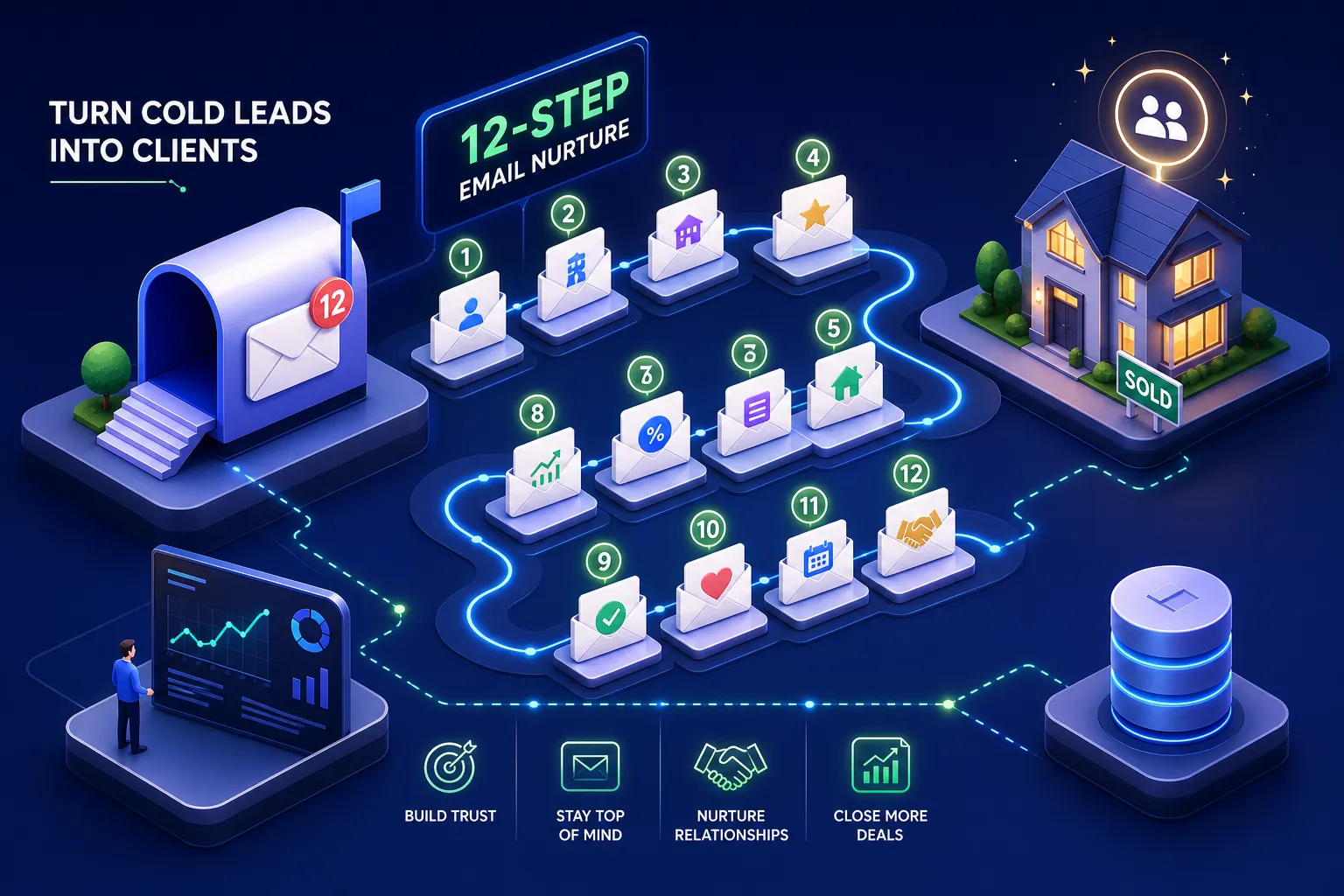
This article walks through a complete 12-step real estate email nurture sequence built specifically for cold leads, with behavioral branching, timing calibrated to long buying cycles, and subject lines that get opened.
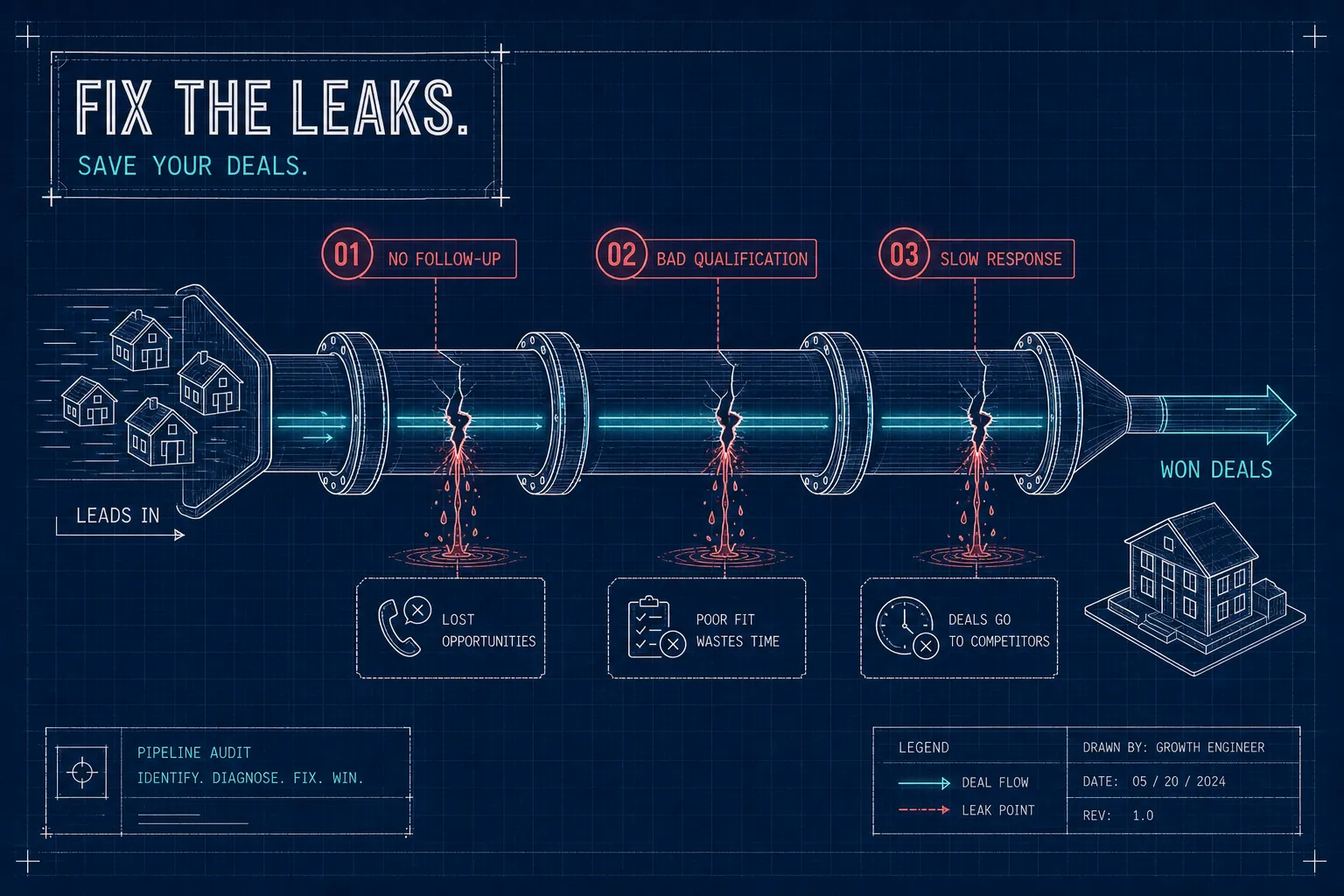
Most real estate agents quit on a lead after one or two follow-up emails with no response, and that pattern costs revenue every single month. Industry data suggests roughly 44% of agents stop after a single follow-up attempt. Yet many buyers who enter your pipeline today are 6 to 12 months away from making a decision, not 6 days. The problem isn't lead quality. It's the absence of a structured email nurture sequence for real estate leads built around the actual buying timeline.
This article walks through a complete 12-step real estate email nurture sequence built specifically for cold leads, with behavioral branching, timing calibrated to long buying cycles, and subject lines that get opened. Every step is grounded in how buyers actually behave, not how we wish they would. VELO specializes in building and deploying these sequences inside CRM platforms for real estate teams, and the architecture below reflects what consistently works in practice.
Why cold real estate leads aren't actually dead
The math behind a 6-12 month buying cycle
Most buyer leads don't convert in week one. They convert when their lease ends, a life change forces the decision, or rate conditions shift enough to make action feel urgent. A lead who went silent three months ago may still be actively searching, they just haven't felt any compelling reason to reply to a generic "just checking in" email.
Industry research consistently shows that approximately 80% of sales conversions happen between the 5th and 12th contact attempt, yet most agents stop after the first follow-up. Leads who receive six or more contact attempts convert at rates roughly 70% higher than those with fewer touches. That gap between persistence and abandonment is where deals disappear.
What "cold" actually means in your pipeline
There's a critical difference between a disqualified lead and a dormant one. A disqualified lead has explicitly said they're not buying, moved out of the market, or purchased elsewhere. A dormant lead opened your first two emails, clicked once, visited your site, and then went quiet. They're not lost, they're just not ready yet.
Treating dormant leads as dead contacts is a fast way to permanently remove revenue from your pipeline. A structured 12-step nurture sequence for cold real estate leads gives you a systematic way to stay visible and relevant until the timing shifts in your favor.
Real estate email nurture sequence: Phase 1 (emails 1, 4)
Re-introduction and value delivery (days 1, 14)
The opening phase of this email nurture sequence for real estate leads delivers value without asking for anything in return. Email 1 is a soft re-introduction built around a neighborhood-specific market update, not a pitch. Emails 2 through 4 rotate between listing alerts matched to their original criteria, a buyer affordability resource or home value estimate, and a short client success story that shows you deliver results.
Keep subject lines 4 to 7 words, all lowercase, and neighborhood-specific. A line like "your [neighborhood] market just shifted" tends to outperform anything that reads like marketing copy, because it signals relevance rather than promotion. Every CTA in this phase should be low-commitment: view a resource, read a story, or reply with a single word. The goal is re-establishing your presence in their inbox before making any direct ask.
Phase 2, emails 5, 8: market intelligence and social proof (days 21, 45)
By email 5, your name has appeared in the lead's inbox several times. This phase builds on that familiarity with bi-weekly market updates paired with social proof: a seller success case study, a "homes that just sold near you" roundup, and one data-forward email showing how the market is moving in their target area. The goal of this phase is to position you as the most informed agent in the market they care about.
Hold the direct call ask until email 8. Emails 5 through 7 should lead with value and treat the relationship as still being built, because it is. A concrete example: email 6 might share a "market shift" data snapshot with a single reply prompt ("Want me to pull the full breakdown for your zip?"). No calendar link. No pressure. Just a reason to respond.
Phase 3, emails 9, 12: direct re-engagement and decision prompts (days 60, 180)
This is where the tone shifts. Email 9 is the honest re-engagement email: short, direct, and written to feel like a personal note rather than a campaign send. Emails 10 and 11 introduce market-driven urgency, rate windows closing, inventory tightening, or price reductions on their saved searches. Email 12 is a soft close that removes pressure entirely: "Still searching or pausing for now? Either way, just hit reply."
A two-option email at this stage often outperforms a single ask because it gives the lead an easy path to respond without committing to anything. (A/B test this against a single CTA in your own sequence to confirm what works for your audience.) The goal isn't to close them on email 12, it's to restart a conversation.
Behavioral triggers that make the sequence adaptive
What to do when a lead opens but doesn't click
An open without a click is a signal worth acting on. If a lead opens email 3 but skips the listing link, trigger a parallel follow-up within 48 hours offering a different asset: a neighborhood guide, a market report, or a short video walkthrough. Format your CRM branching logic around three outcomes:
-
Contact opens AND clicks: Move to hot track.
-
Contact opens AND does not click: Trigger a soft follow-up variant.
-
Contact does not open: Hold and retry with a subject line variation.
This behavioral real estate drip campaign structure keeps each contact in the right lane based on actual engagement rather than assumed intent.
How to handle clicks without a booked appointment
A click signals intent. When a lead clicks your calendar link but doesn't complete the booking, most CRM sequences keep running as if nothing happened, and that's a missed recovery opportunity. Set up an "abandoned intent" trigger: a 2-email micro-sequence that fires within 24 hours of an unbooked click, using a low-friction CTA like a 15-minute phone call rather than pushing a full consultation. If someone clicked and left, the ask was too big. Meet them where they are.
Building the no-show recovery branch
No-shows are one of the highest-leverage recovery scenarios in any real estate pipeline. A lead who booked and didn't show was interested enough to schedule, they're not a cold contact. The no-show recovery runs three emails: one sent 1 hour post-no-show (empathetic in tone), one at 24 hours (a simple reschedule offer), and one at 72 hours (brief, curious, no pressure). Keep the tone warm throughout. A lead who no-showed is statistically closer to closing than most contacts still sitting in your main sequence.
Timing and cadence for long buying cycles
The optimal send schedule to avoid inbox fatigue
For leads in a 6-to-12-month buying cycle, send frequency matters as much as send content. Emails 1 through 4 run on a 2-to-3-day cadence. After day 14, the sequence spreads to every 10 to 14 days through Phase 2, then shifts to once per month through Phase 3. Mid-week sends, particularly Tuesday through Thursday, tend to outperform other days for real estate email drip campaigns, with 10 a.m. and the 1, 3 p.m. window in the lead's local time zone producing the strongest engagement across most datasets.
How to stay relevant without burning the list
The most common unsubscribe trigger in a long sequence is content that feels irrelevant to where the lead is in their journey. Use conditional content blocks tied to how each contact originally entered your CRM, buyers see buyer-specific content, sellers see seller-specific content. Pausing the sequence automatically when a contact replies, regardless of which email prompted it, is a FAQ, VELO Agency | CRM, Compliance, Attribution & White-Label. Sending email 6 of a nurture sequence to someone who just replied about a listing is the fastest way to lose trust you spent months building.
Benchmarks, A/B testing, and what good performance looks like
The 2026 real estate email benchmarks you should measure against
Open rates for real estate email campaigns currently average 20, 35%, with well-segmented sequences reaching 40, 50%. Click-through rates average 1.77, 2.98% industry-wide but should target 2.5, 5% for a properly built nurture sequence. Unsubscribe rates should stay below 0.27%. Use CTR as your primary performance indicator in 2026, not open rate. Apple Mail Privacy Protection inflates open metrics by 25, 35%, making click-through rate the more honest measure of actual engagement and sequence health. See a recent industry summary for the 2026 real estate email benchmarks to set realistic targets for your program.
The three A/B tests worth running first
Not all A/B tests move the needle equally. The three highest-impact variables in real estate email templates and nurture sequences are: subject line style (question-based versus neighborhood-specific), CTA copy (soft curiosity-based versus a direct booking link), and send day (Tuesday versus Thursday). Run each test as a 50/50 split, wait for at least 200 sends per variant before calling a winner, and test one variable at a time. Testing subject line and CTA simultaneously makes it impossible to identify what actually drove the change. For examples you can adapt, review curated high-converting real estate email templates to jumpstart your creative variations.
Deploying a real estate email nurture sequence in your CRM
CRM triggers and segmentation rules that make it work
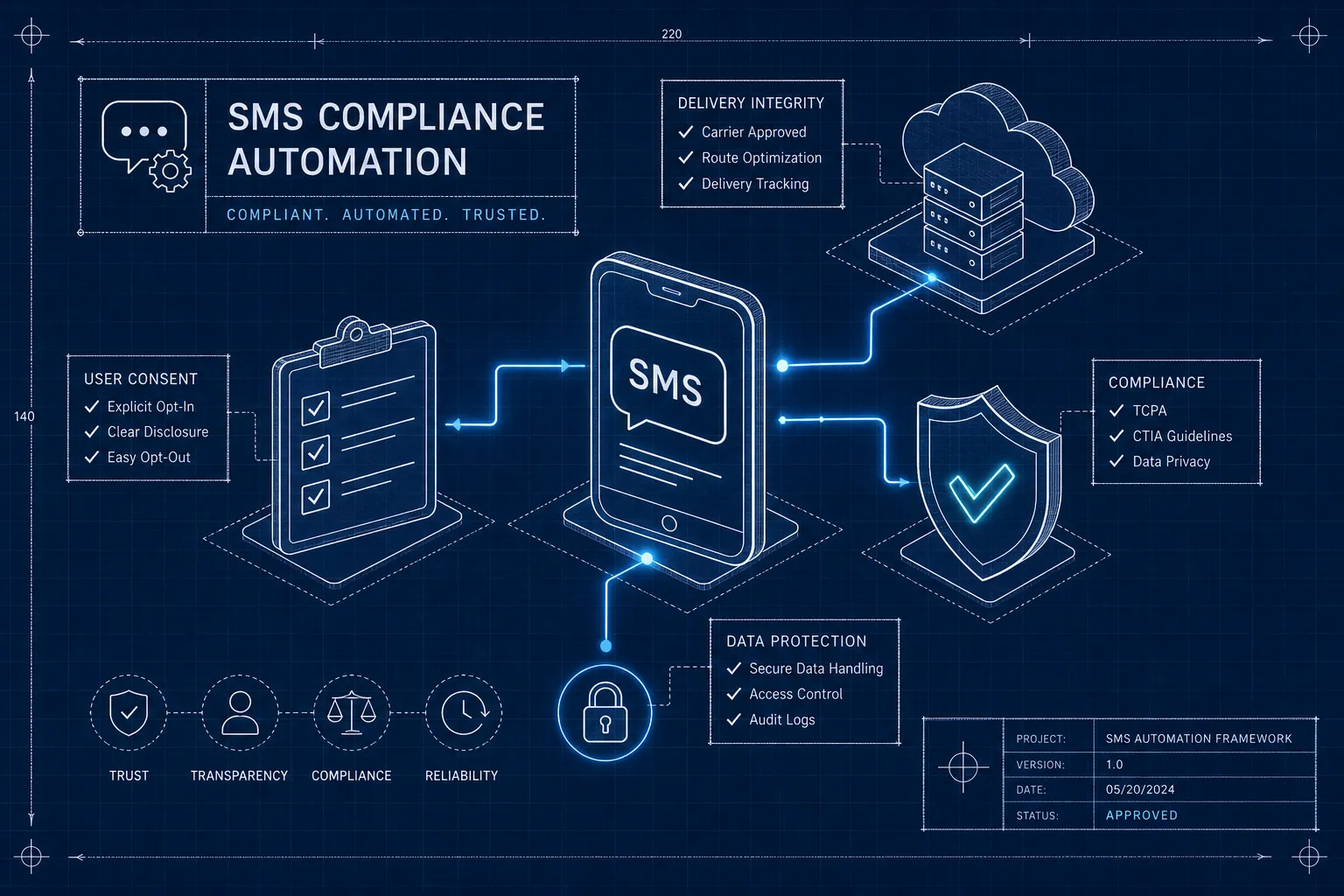
A well-written sequence running on flawed trigger logic will still underperform. Four setup rules are non-negotiable for any email drip for realtors deploying this kind of architecture. First, the entry trigger should use a lead source tag plus a last-activity date threshold of 30, 60, or 90 days inactive. Second, behavioral branching rules for open, click, and no-show scenarios must be configured before the sequence goes live. Third, exit conditions need to be clearly defined: reply received, appointment booked, or deal stage changed. Fourth, re-entry conditions should account for leads who go cold again after initial re-engagement. This sequence is compatible with platforms like GoHighLevel, HubSpot, Follow Up Boss, and ActiveCampaign, though setup complexity and native automation capabilities vary by platform.
Why real estate teams work with VELO to build and run these sequences
Real Estate, VELO builds and deploys these sequences inside CRM platforms, handles the behavioral trigger architecture, runs ongoing A/B tests, and manages performance through a Full-Stack Growth Retainer, VELO.
For teams running paid ads into a CRM, a broken or generic nurture sequence is one of the fastest paths to lost ROI. Getting this right, and keeping it optimized, is the difference between a contact list and a revenue engine.
Cold leads are worth fighting for
Cold leads are not dead leads. A 12-step email nurture sequence for real estate, built around behavioral triggers, realistic buying timelines, and tested subject lines, gives teams a systematic way to stay in front of prospects until the timing shifts. It works because behavior drives the timing, not the calendar.
If you're currently running paid ads into a CRM without a structured nurture sequence in place, you're likely losing deals that were nearly won. A free 30-minute pipeline audit with VELO will show you exactly where those leads are falling out and what it takes to build a system that captures them. The audit is free, and the written roadmap lands in your inbox within 48 hours.