
Annuity & Retirement Advisory
One CRM architecture, replicated across a national network of independent annuity advisors — and operated centrally by a small team.
- Client
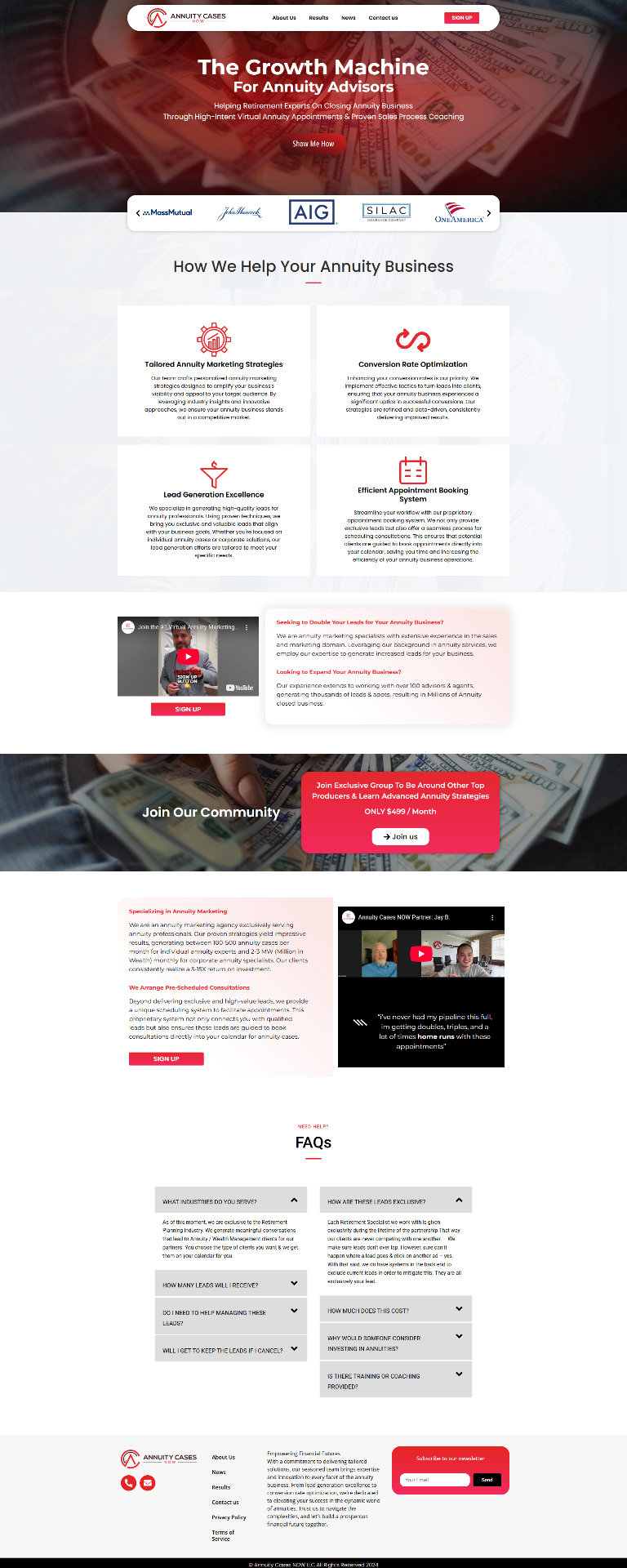
- Annuity Cases Now — New York, NY
- Engagement
- Oct 2023 – Mar 2025, built & operated
- Platform
- GoHighLevel + Twilio ISV
- Scale
- 40+ advisor accounts on one standard
Scope
GoHighLevel CRM architecture, lead distribution, speed-to-lead automation, multi-channel nurture and source attribution — built once as a standard, deployed per advisor, operated centrally.
The situation
Annuity is a slow-close, high-value, compliance-heavy sale. A prospect requesting a retirement income review is not buying this week. They are comparing three advisors, talking to a spouse, and making a decision over weeks. The lead cost is high because the policy value is high, and that combination makes every failure in the follow-up chain expensive in a way most verticals never feel.
Independent advisors are also, structurally, solo operators. There is no marketing team and no ops person. The advisor is the one running the appointment, and the same advisor is the one supposed to be calling back the lead that came in during that appointment. That does not happen, so it does not get done.
The result is a pattern that repeats at every advisor desk. Paid leads arrive from Facebook and Google. Response happens when the advisor next checks their phone, which might be four hours or the following morning. Whoever called first has already booked the appointment. The leads that do not convert immediately are never touched again, because no system is holding them, and the advisor has no idea which source produced the ones that closed.
Multiply that by hundreds of advisors and the problem is not the follow-up. The problem is that no two advisors do it the same way, so nothing can be measured, improved or fixed once.
The approach: build once, deploy per advisor
The unit of work here is not an account. It is the standard.
Every advisor gets the same architecture: identical pipeline stages, identical custom fields, identical workflows, identical source attribution, identical templates. Not because advisors are identical, but because a standard is the only thing that makes hundreds of accounts operable by a small team. A fix made once propagates. A metric measured in one account means the same thing in another. An advisor who needs help gets support from someone who already knows exactly where everything is.
The alternative, which is where most multi-account operations end up, is every account hand-tuned into a slightly different variant, none of them documented, all of them fragile, and no meaningful reporting across any of it.
Speed to lead
Inbound lead triggers outbound contact before any human is involved: an immediate SMS on the first workflow node with no buffer delay, so first touch lands inside sixty seconds of the form hitting the CRM. Email follows, then a call task and ring to the advisor, with the whole prospect record routed to the right desk in under two minutes.
Messaging runs on a dedicated Twilio ISV configuration at the network level rather than a shared sending pool, so the first SMS is not queuing behind other tenants' traffic. The constraint on first touch is workflow trigger latency, not infrastructure.
This is the first thing built and not the fifth because no downstream nurture recovers a lead that went cold in hour one. Every other automation in the account is worth less if this one is missing.
Routing solved structurally, not procedurally
Each advisor operates their own isolated CRM instance, so a lead enters the correct account at the point of capture rather than landing in a shared pool that something has to distribute afterward.
That removes an entire failure category rather than managing it. Round-robin assignment breaks when an advisor is on holiday. Geographic rules break on edge cases and misfiled postcodes. Capacity-based routing needs capacity data that is always stale. None of those failure modes exist when the lead never needed routing in the first place, and the advisor's own funnel is the point of entry.
Multi-channel nurture built for a long decision window
Email, SMS and voicemail drop sequences running across the actual annuity decision cycle rather than a seven-day sprint: forty-two days, twenty-one touches, weighted heavily into the first seventy-two hours and then tapering to a weekly cadence through week six.
Branching on behaviour, so a prospect who opens and clicks is treated differently from one who has gone silent, a no-show drops into its own five-touch rebooking sequence, and a booked appointment pulls them out of nurture entirely. Anyone still unconverted at day forty-two moves to a monthly long-hold list rather than being dropped.
Lead scoring and qualification
A scoring model separating prospects worth an advisor's calendar hour from those that need to keep warming. Points weighted across five inputs: investable asset band, age band relative to the retirement window, stated decision timeline, engagement (opens, clicks, replies, quiz completion) and lead source quality.
Qualification is captured as structured custom fields rather than free-text notes — so it is queryable and reportable rather than trapped in a conversation thread, and the same field means the same thing in every one of the accounts.
Source attribution
Every lead carries its origin through the entire pipeline: Facebook, Google, organic, referral, down to campaign level. Cost per qualified lead and cost per booked appointment become answerable questions rather than estimates.
This is where most advisor CRMs are effectively blind. Spend is allocated on instinct because the CRM records that a lead exists but not where it came from, and by the time it becomes an opportunity the origin is long gone.
Pipeline
Ten stages tracking the annuity motion from first capture through to submitted application:
- Opt-In
- Quiz Answered
- 1st Virtual Appointment Booked
- 1st Appointment No Show
- 1st Appointment Showed
- 1st Appointment Showed — Lost
- 2nd Appointment Booked
- 3rd Appointment Booked
- Closing Opportunity
- Application Submitted
The structure encodes two things most sales pipelines leave implicit. No-show is a stage, not a note, because in annuity a booked appointment that does not happen is the single most common failure point and it needs its own recovery path rather than being absorbed into a generic "contacted" bucket. And second and third appointments are stages, because a retirement income decision is rarely made in one sitting and a pipeline that ends at "meeting held" cannot see the difference between a deal progressing and a deal stalling.
Lead source is captured on every opportunity record and carries through the pipeline, so each appointment type and campaign is traceable from entry to outcome.
Stage advancement is event-driven, not clerical. Calendar booking, attendance outcome and application submission each fire a workflow that moves the opportunity, so pipeline position reflects what actually happened rather than whether a solo advisor remembered to drag a card.
Reporting
Stage-level conversion and source performance are visible at a glance, so an advisor can see where records are accumulating and which appointment types and campaigns are producing them. Cost per qualified lead and cost per booked appointment are reported per source, per account and rolled up across the network.
Reporting is deliberately volume- and conversion-based rather than forecast-based: policy value lands in the carrier's system, not the CRM, so the pipeline is measured on movement between stages instead of a monetary figure the CRM cannot verify.
Operating it at scale
Standardisation is what makes the maths work. The same person can support many advisors only when every account is recognisable on sight.
Snapshot-based provisioning means a new advisor is live with the full architecture in place inside a day rather than waiting on a build. Central operation means the fix gets made once and rolls out, instead of being rediscovered account by account. Across the engagement the standard ran on 40+ advisor accounts, supported centrally without a per-advisor ops hire.
Results
- 40% increase in qualified lead generation — measured on scored-qualified contacts per month per advisor, before and after the standard replaced ad-hoc follow-up.
- 35% improvement in lead-to-appointment conversion — opt-ins reaching a booked first virtual appointment, tracked on the pipeline stage rather than self-reported by advisors.
- Sub-sixty-second first touch, under two minutes to the right advisor — automated SMS on the first workflow node, with the record already sitting in the correct isolated account at capture.
- Cost per qualified lead became a reported number — before attribution it was an estimate reconstructed from ad platform totals; after, it was reported per source and campaign, and spend moved accordingly.
- 40+ advisor accounts operating on one architecture — identical stages, fields, workflows and templates, operable by a small central team.
Every figure above has a source that can be named in a sentence. A number that cannot be traced is worse than no number, because it turns a credibility asset into a credibility problem in the middle of a sales call.
What transfers
Insurance and annuity is a regulated, long-cycle, high-ticket sale. Strip that away and what remains is the shape underneath: expensive inbound leads, a solo or small-team operator who cannot answer them fast enough, a decision window measured in weeks, and no attribution connecting spend to closed revenue.
That shape is identical in restoration, in aesthetics, in home services and in professional services. The compliance language changes and the decision window stretches or compresses. The leak does not move.
- Speed to lead is the first thing built, not the last. Automated first touch before a human is in the loop. Nothing downstream recovers a lead that went cold in the first hour, which makes every other automation in the account dependent on this one working.
- Attribution has to be captured at entry. Source attaches at the moment the lead is created and travels with the record to close. Retrofitting it later means reconstructing origin from memory, which is another way of saying guessing.
- Standardise before you scale. One architecture deployed many times is operable by a small team. Many architectures deployed once each are not operable by anyone, and the difference compounds with every account added.
Built by VELO. Production CRM and revenue systems, deployed in 14 days.
Book a 30-minute audit. We'll walk your current pipeline live, identify the three highest-leverage gaps, and send a written roadmap within 48 hours.
Book a Free Pipeline Audit